

‘How do you get into that rubber stuff?’
Reveal Part 44: In which the Rubber Goddesses are interviewed by a young Ben Elton for a documentary that never airs, and I go in for another round with half of Duran Duran

The media had been slow to pick up on the Skin Two phenomenon, but they finally made the Roland Rat/David Claridge connection and there was a brief flurry of “TV puppet in sex club shocker” exposes about him in the tabloids. But he was a smart operator and had already decided to move on from Skin Two, so it didn’t do his career much damage.
With Claridge’s departure, Skin Two was renamed Maitresse, after the classic French film about a dominatrix, starring Gerard Depardieu. Because of the recent press interest, a documentary team working for London Weekend Television’s South of Watford culture and arts series decided to make an episode about the scene, and its researchers were looking for willing, articulate participants.
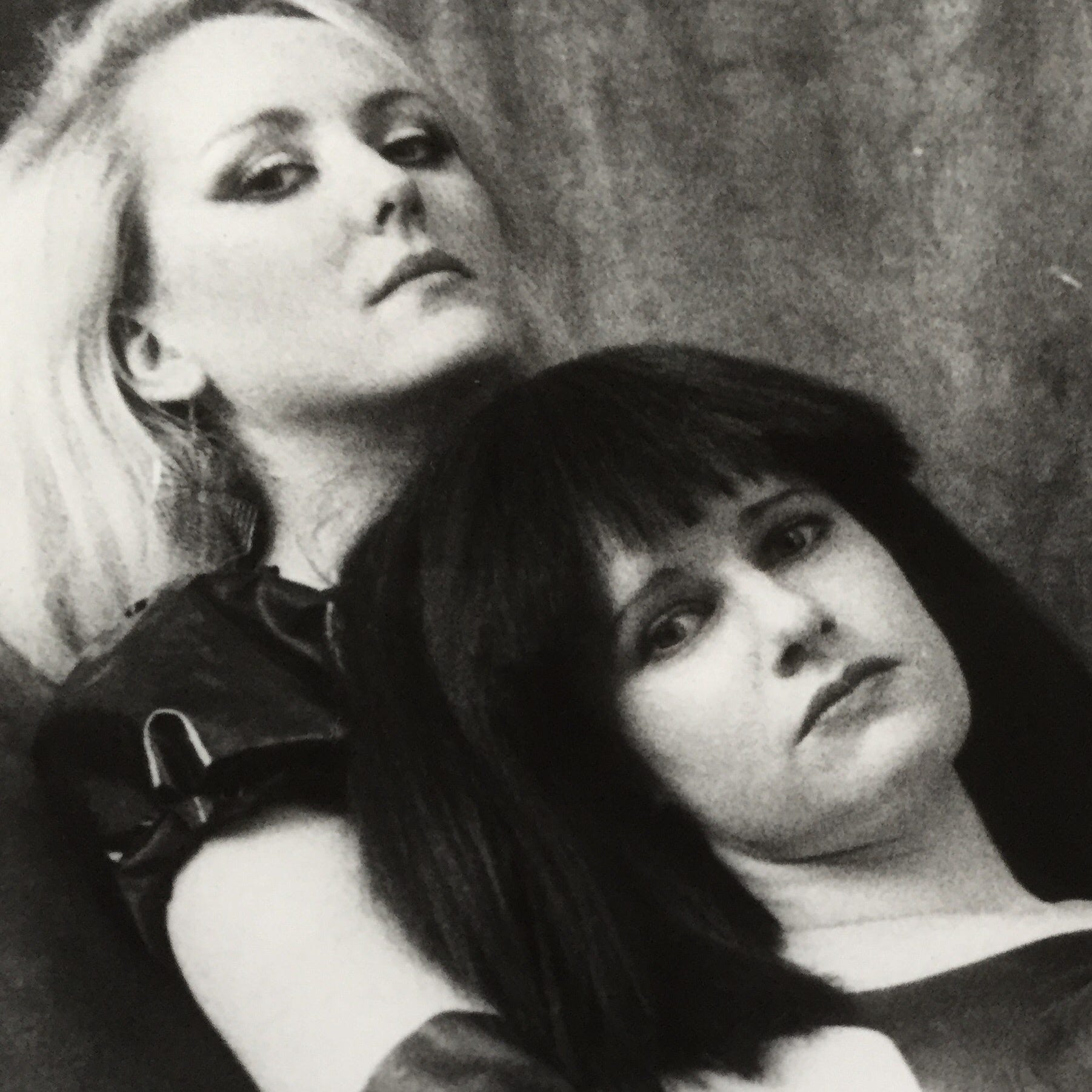
Most of the Skin Two/Maitresse hardcore didn’t want their faces shown, but Gill and I weren’t bothered about a little thing like that – after all, we’d already appeared on the cover of Skin Two magazine. We agreed to take part, and turned up in our full latex gear at Tony’s flat to be interviewed by the show’s presenter, an up-and-coming alternative comedian called Ben Elton.
To no one’s surprise, Elton treated the whole thing like a joke, although we could both tell he was fascinated, in a leery kind of way, by the two of us and what we might get up to in the privacy of our bedrooms – or should that be dungeons? His questions were hardly probing – “How do you get into that rubber stuff?” was about the level of it – but Gill decided to make her point forcefully before disappearing in a puff of talcum powder.
“We have to help each other get dressed due to the constricting nature of the clothing,” she said, gesticulating at the lens and reducing me to a nodding dog by her side. “Then it’s out with the Mr Sheen!”
She quickly realised this might descend into the realms of the trivial; I couldn’t get a word in edgeways, so she carried on.
“I get really annoyed when people say we’re pandering to male fantasies,” she said, fixing Elton with one of her stares. “We’re not. We’re expressing our sexuality. I suppose we’re quite aggressive people. We choose to dress like this and I think that’s a strong feministic statement in itself. We’re doing this for ourselves, not for men.”
That shut him up for a moment but he became pushier off camera, clearly keen to discover whether or not we were a couple and what we got up to with our whips, ropes and chains. We thought about winding him up with stories of hot lesbo action but in the end we couldn’t be bothered.
The majority of the filming took place at Maitresse, where everyone present had to agree to appear in the programme or cover up their faces. Elton was there again, rubbing his hands together with glee and observing the assembled throng of latex-clad lovelies. I was worried the programme might be a stitch-up job but was relieved to see, in an early edit, that at least one sensible statement of mine had been included. “It’s a very ritualistic way of dressing,” said my voiceover to a shot of me in chainmail and red rubber, “and I enjoy that ritual, the exhibitionism of it, because it’s the last taboo. I don’t think it will ever become acceptable to wear rubber.”
Sadly, our masterclass in how to wear latex was never seen by the viewing public. LWT bottled out of broadcasting a documentary about such a taboo subject as bondage and domination, denying Mr Elton an unusual inclusion on his CV. There was nothing too juicy on the programme but there were rumours that someone high up at Channel 4 had connections with the scene and didn’t want to be found out. Fancy that. Just like Frankie Goes to Hollywood, we’d been banned!
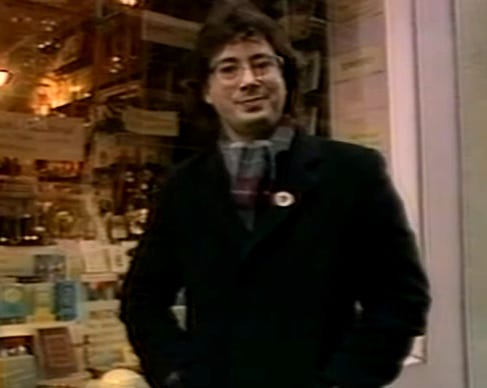
Back in the real world, the Flash Harry episode had not cured me of Dik-itis. It wasn’t long before I managed to find a reason to visit Birmingham to see him. He had been asked to take part in a BBC Pop Quiz weekend at a local hotel, so I made sure I covered the event for Record Mirror, under the pretext of doing mini-interviews with the assembled chart stars. However, apart from a quick chat with a bemused UB40 and a few words with an inanely grinning Nick Heyward of Haircut 100, I was totally focused on enjoying myself with my black-leathered friend – with a little help from my new chum, Charlie.
I’d taken a gram with me expecting it to last the weekend, but it lasted barely an hour. Like naughty children, Dik and I found a quiet kitchen and set about chopping out a few lines on a stainless steel work surface. It was easy to forget that I was in possession of a Class-A narcotic – I could have lost my job, at the very least, if anyone found out what we were up to. We thought we’d been really clever until we were disturbed by the sound of a door slowly opening. I froze, realising in that instant the risk I was taking. Then Dik greeted the face at the door like an old buddy, and in walked the tall, slightly balding singer of a well-known rock group.
“Can you spare any of that for a man in need?” he said in his warm Scottish tones.
“Yeah, sure,” I said, not really meaning it. Thus it was that I watched half my precious, expensive nose candy disappear up a rock star’s nose. It wasn’t as if he couldn’t afford his own.
“Fucking hell, Dik, this stuff doesn’t grow on trees,” I blustered after the drug thief had departed. “But what’s the point of taking it if you can’t share it?” he countered.
“Fine, as long as it’s your money that’s paying for it…” I said, stomping off, sharpened to a point by the cocaine.
Our meetings always seemed to go this way – probably because they were pregnant with my expectations. I’d often focused several months’ worth of anticipation into our sporadic reunions – so much so that when they finally happened, we’d end up having silly arguments. As soon as we were together, I would be thinking about when I’d see him again, thus neatly ruining the quality of the moment.
Of course, when cocaine and alcohol entered the equation – which they usually did, on both sides – feelings that were already running high began sprinting off the graph. I began to wonder whether the essence of our “affair” was based on addiction. Me, addicted to the emotional highs and lows; him, hooked on the secrets and lies – not to mention the drink and drugs. We rarely had dream weekends, because reality always intruded – even when we had done our best to shut it out with artificial stimulants. This time, I arrived back at Euston determined to break out of my cycle of self-abuse. And that meant no more white lines – for the moment.
The time had come to catch up with my other Brummie pals. Duranmania had reached its peak and it was clear that the Fab Five were in danger of burning out. The pressure was piling on them to keep making platinum records and ever more preposterously expensive videos. This market-driven madness reached its climax with the Wild Boys promo – a Mad Max-style sci-fi epic featuring Simon Le Bon lashed to a wheel that plunged his head underwater at every turn. (The contraption jammed once when he was submerged; it was something of a portent, as he was soon to have a lot more trouble with water.)
The call had also come from Cubby Broccoli, asking the band to write the theme tune for the next Bond movie A View To a Kill. It seemed the Duran Duran machine was crushing it, as planned. So, here were five rich, famous young men who didn’t need to do another day’s work in their lives but, after a few years of pop superstardom, they wanted some “head space”. John and Andy Taylor – the rock/R&B faction – broke away first to form the Power Station with rock veteran Robert Palmer and session drummer Tony Thompson.
Roger Taylor, Nick Rhodes and Simon Le Bon – the arty electronic faction – responded with Arcadia. Sources close to Duran Duran told me these projects were going to make the band “appeal to a new demographic”. My considered opinion was that they were desperately trying to be rich, famous and critically acclaimed.
I made my way to the Montcalm Hotel – scene of that riotous evening with Sylvester – expecting to witness a flexing of ego muscle and much talk of units and rack momentum. I was greeted in the lounge area of the Power Station suite by Robert Palmer, who oozed the sort of elegance that comes from a lengthy period of comfortable success – expensive Caribbean tan; cashmere jumper; soft leather trousers; gleaming white teeth. But he had a no-nonsense Yorkshire attitude that I immediately warmed to. Tony Thompson (who’d worked with Chic and David Bowie) joined us and we talked about their single Some Like It Hot, a stomping rock-dance crossover track.
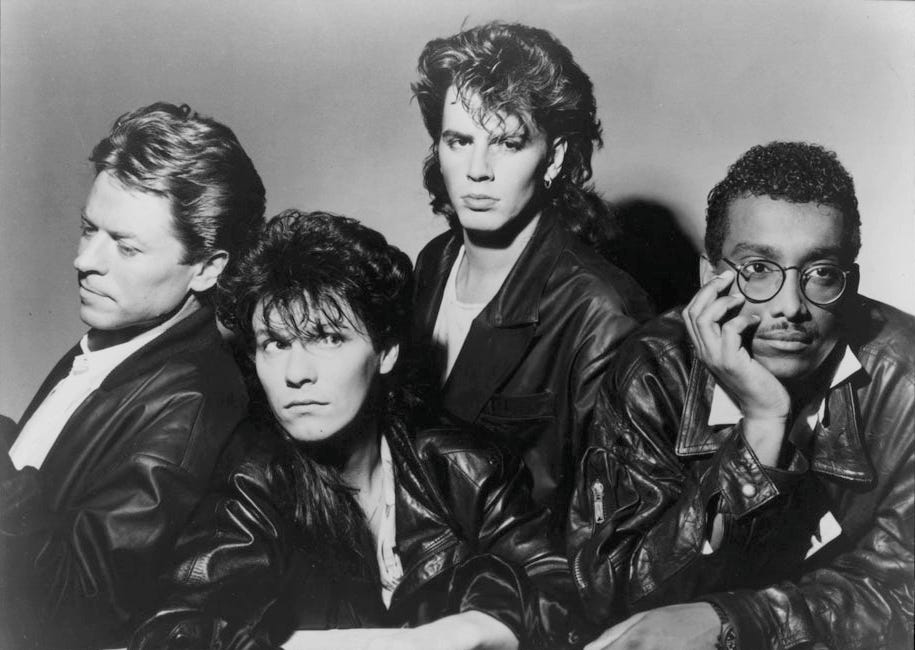
John Taylor, a die-hard Chic fan, had never let go of his dream of mixing rock and R&B and had wanted to collaborate with Palmer for some time. He’d met Thompson on the Bowie tour, then it all clicked and a “spontaneous chemistry” of personalities fizzed into action.
“It just rollercoastered,” said Palmer, describing the process by which things happen in the world of high-society pop. Cue the grand entrance of JT, face newly covered in panstick, down the spiral staircase, modelling a dress - red, black, with cosmic patterning. Thankfully, he was wearing black leather trousers underneath.
“Guess what?” I announced to the descending vision. “I like the single!” He looked at me knowingly and proclaimed himself pleased.
“It’s only now that I’m starting to think, ‘Hey, I hope it’s a hit’,” he said. “Usually with Duran we’d be saying, ‘Is this a No 1 or isn’t it?’ It got so bad with us that when Union of the Snake got to No 3 everyone said, ‘That’s it, it’s over.’”
For JT, the Power Station was a much-needed rest from the demands of pop stardom. “I was getting to the point with Duran where I was going through stock basslines like I go through stock answers in interviews,” he told me. “I had to find another way of doing things. The hardest thing for me was playing in front of Bernard [Edwards, producer]. I left the studio in tears one night because I didn’t know if I could play to his expectations. It came at the point where I needed it. The Reflex was No 1 in the States and I could have got really arrogant.”
‘What do you mean could have?’ I thought. John had a first-class degree in self-importance. I still liked him, but sadly he’d turned into an ego monster driven by an odd mixture of arrogance, insecurity and who knows what else? Well, I could have given it a guess…
NEXT WEEK: 'We needed a holiday from Duran Duran’
Well, I guess Duran had their own little Maslow's Pyramid going on, and once they'd amassed enough fame and riches, an esoteric desire for critical acclaim was probably only natural. And I think they probably got what they wanted with both the Power Station and Arcadia, but, and especially for Arcadia, not the customary sales and attention they'd have almost certainly wanted.
Did you interview Arcadia, too, Beverly? Hope so!
Do you ever think that the younger you was another person entirely from the one writing these entertaining and, ahem, educational missives from the past?
Great, as ever!
Remmbering how "right on" and politically correct Ben Elton was on TV back in the 80s, it's especially funny to find out he was just a regular leery bloke! Haha!