

Don't make me Go West...
Rewind Part 48: Record Mirror struggles to land interviews with major pop stars, and I land in Holland for a flirty interview with Go West on a hotel bed (how very Paula Yates)...

The day before we raised our champagne glasses to toast the relaunch – or “marketplace adjustment”, if you will – of Record Mirror, there were riots in Brixton and I finally saw Dik again. There had been a protracted silence, which I had convinced myself had nothing to do with me – and I was right. He had finally moved out of the flat he’d been sharing with his ex, and it had been by no means easy severing their ties. Here was a man, clearly, who craved emotional support about as much as he needed a drink in the morning – and he needed plenty of those. He had one “proper” girlfriend; another, loosely, ex-girlfriend who seemed to look after him; a few women with whom he maintained contact on and off, especially on tour; and me. Where did I fit in?
He didn’t seem to want to let me go. Now that was plain greedy, but his neediness hooked into my own and kept us unhealthily involved. The confusion that resulted from this state of affairs sent me off into an emotional pinball game, ricocheting from party to bar, getting hideously drunk with record company pals at the trendy new Soho Brasserie and the Video Café and modelling rubberwear for new designers.
I decided through this haze of kamikaze behaviour that I really had to do something about Dik; I had to force the issue, one way or another. But, rather than admitting defeat, I upped the ante.
“Dik…”
“Yes bab…”
“Listen to me…”
“I’m listening…”
“Will you run away with me?” [Silence…] “I’m serious. I’d go anywhere with you…”
[Still silence, but a growing awareness of horror coming down the line from Birmingham.]
“Ummm… look, no, I can’t… sorry bab… you’re lovely, but…”
“OK, fine. I just needed to know. I’ll speak to you soon…”
Even though I knew he wouldn’t say yes (and I would probably have been horrified if he had), I was still left feeling as if I was wearing my skin inside out. I vowed to begin the long, slow process of letting go.
Post-Live Aid, the big acts just got bigger and rarely did interviews. We might, after some heavy negotiating which usually involved the promise of a cover, get Annie Lennox, George Michael or Tears For Fears, but most of the stars didn’t trouble themselves with second-rung pop magazines such as rm. They might do one interview with the NME, one with The Face and another with Smash Hits, just to prove they understood the range of their audience, but if you weren’t a market leader you didn’t have a chance.
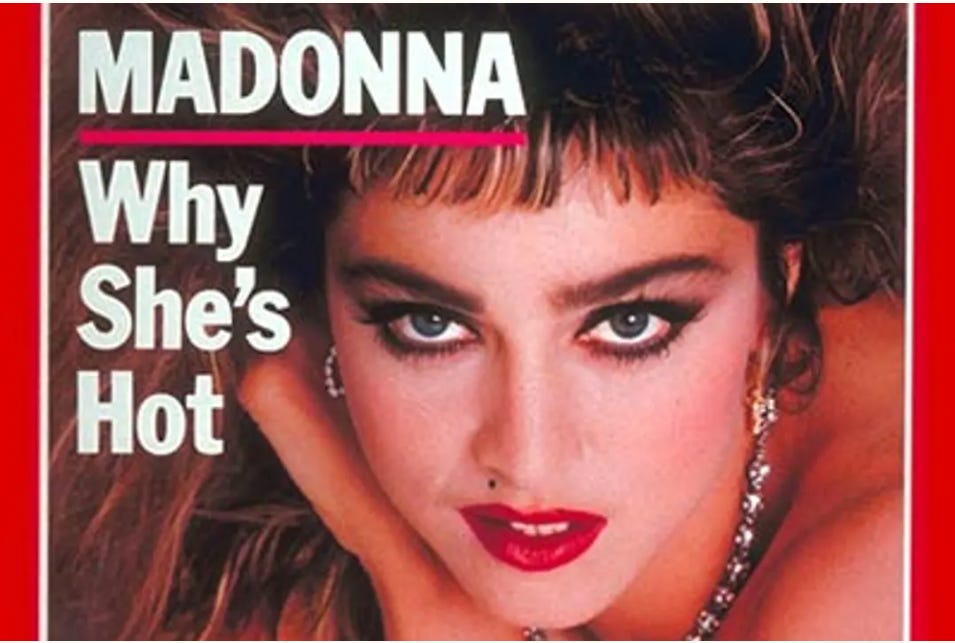
Dire Straits’ Brothers In Arms and Bruce Springsteen’s Born in the USA had taken up residence in the charts thanks to the new Compact Disc format, as had anything by Phil Collins, Sting and U2, but we didn’t want to talk to them anyway. Madonna, whose star we had spotted rising in 1983, had gone stratospheric, selling more singles in 1985 than anyone else. But now she was a fully-fledged phenomenon and way out of our reach. So we were left with a reasonable slice of the Smiths, a lot of dance music (great but largely faceless) and plenty of up-and-coming combos, many of which turned out to be no-hopers. The acts that really sold records no longer appeared in rm. We were officially “alternative”.
The charts were not, however, entirely dominated by acts that had grown fat on their post-Live Aid success. Chrysalis had struck gold with a Twickenham twosome called Go West – aka Peter Cox and Richard Drummie. Their debut single, We Close Our Eyes, reached No 5 in the charts and their next two singles had performed well. I liked their high-octane, soulful synth-pop and particularly their image – all vests, muscles and general ruggedness.
It soon became an office joke that I fancied Richard Drummie, the dark-haired one, so it was cause for great amusement when I was booked to do a telephone interview with the band while they were on tour in America. However, on the day, it was frontman Peter who had been tasked with speaking to me. I soon began trading banter with the singer, who turned out to have a dry, self-deprecating sense of humour. He told me he was never that confident about anything, so we had a lot in common.
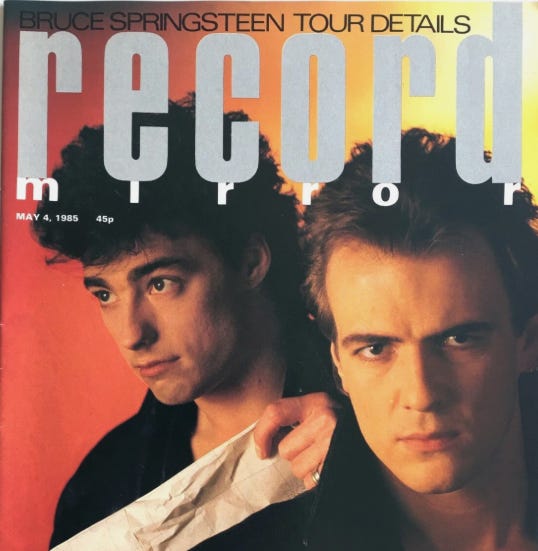
Come October, my friends in the press office at Chrysalis had persuaded me that it would be a good idea to go to Holland to interview Go West in person. I was transported to a studio somewhere in the Hague where the band were recording a video. I didn’t get to meet Pete and Richard properly until we were back at the band’s hotel in Doetinchem. When I did, it quickly became clear that I wouldn’t be able to joke about muscles and vests.
Rich was far more likely to go for it in any situation and adjust to the often ridiculous demands of being a pop star. Pete didn’t feel comfortable in this role and emerged as the eternal doubter who questioned everything, and thought a bit too much for his own good. He looked as if he’d rather be somewhere else half the time. However, they both had a robust sense of humour that had helped them through one hell of a year.
After a blinding start with We Close Our Eyes, Call Me and Goodbye Girl were unable to match its chart performance. The band were at a critical point in their career – approaching their first UK tour and that “difficult” second album – and I felt it was up to me to ask a few leading questions. The interview took place on a hotel bed – how very Paula Yates – but all my notions of objective reporting went out of the window when my eyes locked with Pete’s. I was thrown by the meaningful glances we were exchanging across the mattress.
“You don’t seem to have the killer instinct,” I lobbed.
“Absolutely not,” parried Pete. “In America, we constantly meet career-orientated people who are very conscious of where they are in their lives. I’m not like that.”
“So what are you doing this for, then?” I shot back.
“Because it’s fun, it’s really that simple,” he said, artfully dodging.
“You seem to have low self-esteem. You keep saying how terrible you look,” I ventured, rather unfairly.
“It’s not that,” countered Pete. “We just don’t want to blow our own trumpets.”
“But if you don’t, who else will?”
“If people like the records they’ll buy them. It’s a disposable, unimportant thing.”
“It’s not unimportant! Your records are really good!”
“Anyone who thinks they’re great is labouring under a misapprehension,” Pete continued. “Maybe one single is made every decade that could be said to have a major effect on people’s lives.”
“OK, you believe in what you’re doing but you don’t communicate it very well.”
“If people interpret the way we are as false modesty we’re on to a loser because I don’t want to be the kind of person who says we’ve made a fucking great album and everyone should go out and buy it.”
“So what’s the answer?” I asked.
“I think you have to be yourself while maintaining your sanity… Wearing a pink dress,” said Pete, finally showing some levity. “Wearing a pink dress and maintaining some kind of protective persona.”
The interview ended in the small hours of the next morning and I realised I’d been a lot more challenging than I would usually be in such a situation. I was testing the boundaries with Pete, seeing what he was made of. I wanted to find out what made him tick. I’d been flirty, sarcastic, cheeky – and sometimes borderline rude. Why was I doing this? Because I’d made an instant yet unfathomable connection with this man and didn’t have a clue what to do with it. I scuttled back to my hotel room in a state of shock and was still reeling when I flew back to London the next morning.
NEXT WEEK: East End boys and West End girls…
He does have rather magnetic eyes. I can see why you were transfixed!
Did you, erm, ask him to ‘Call me!’?
They seemed likeable enough, but always looked like a pale shadow of Wham!, but then again, so did most duos, apart from the Pet Shop Boys.